IPL fans hear commentators mention strike rates constantly. “He needs to up his strike rate.”
“That’s an incredible strike rate.” But what is the strike rate in cricket? And why does it matter so much in the IPL?
Strike rate measures speed. For batters, it shows how fast they score runs. For bowlers, it reveals how quickly they take wickets.
The catch? These work in opposite directions, which confuses even experienced fans.
What Is the Strike Rate in Cricket?
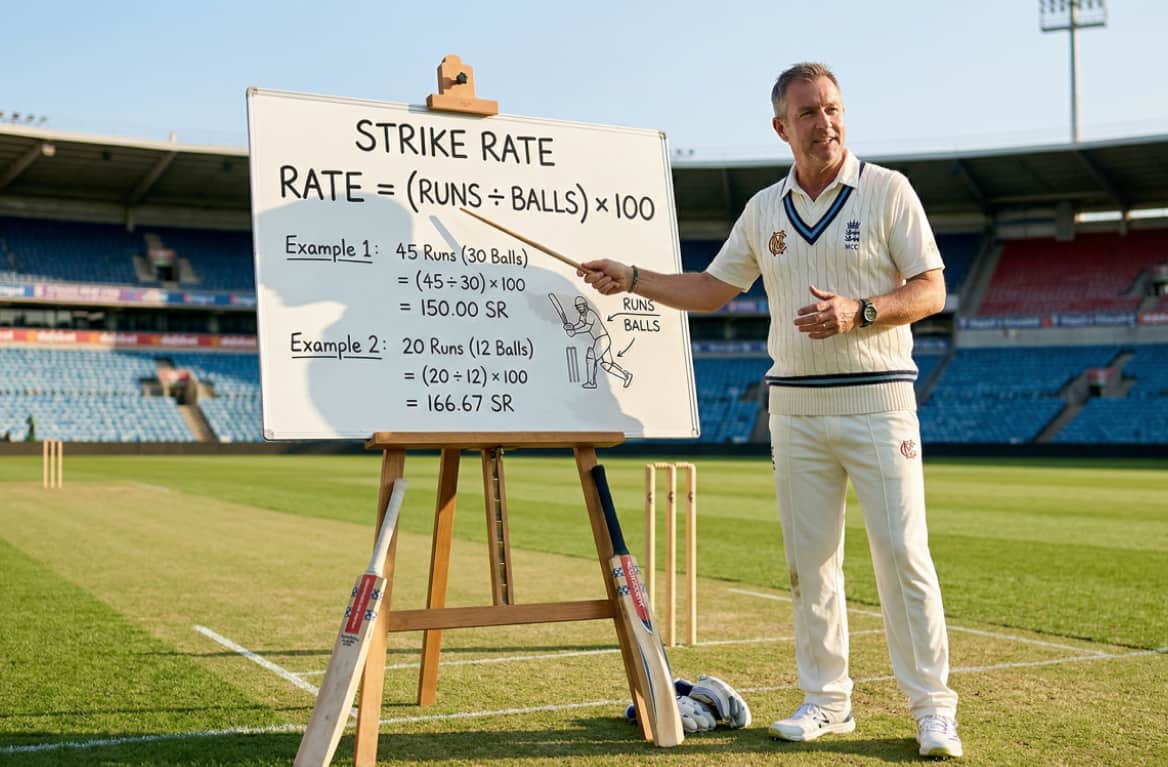
This guide breaks down the strike rate clearly.
You’ll learn both formulas, see real IPL examples, understand what makes a good strike rate in T20 cricket, and discover why franchises pay millions for players with elite strike rates.
Strike Rate Meaning in Cricket
Strike rate meaning in cricket depends entirely on whether you’re discussing batting or bowling.
- Batting strike rate: Runs scored per 100 balls faced. Higher numbers mean faster scoring.
- Bowling strike rate: Balls bowled per wicket taken. Lower numbers mean quicker wicket-taking.
This creates confusion. A batting strike rate of 160 in the IPL is excellent, scoring 1.6 runs per ball.
But a bowling strike rate of 160 would be terrible, needing 160 balls (26.6 overs) for just one wicket.
Always check the context. Is the stat about batting or bowling? That determines whether bigger or smaller is better.
What Is Strike Rate in Batting?
What is strike rate in batting? It’s the number of runs a batter scores per 100 deliveries faced.
Batting Strike Rate Formula
- Strike Rate = (Runs Scored ÷ Balls Faced) × 100
IPL Example
Suryakumar Yadav scores 83 runs off 50 balls for the Mumbai Indians:
- Strike Rate = (83 ÷ 50) × 100
- Strike Rate = 166
This means scoring 166 runs per 100 balls, or 1.66 runs per delivery. That’s elite IPL batting.
Understanding the Numbers
- Strike rate 100: One run per ball (too slow for IPL)
- Strike rate 130: Acceptable IPL batting
- Strike rate 150: Good aggressive batting
- Strike rate 170+: Elite power hitting
In IPL cricket, anything below 120 puts pressure on your partners. Above 150 changes in matches. Above 180 wins games single-handedly.
Bowling Strike Rate Explained
Bowling strike rate reverses the logic. Lower is always better.
Bowling Strike Rate Formula
- Strike Rate = Balls Bowled ÷ Wickets Taken
IPL Example
Jasprit Bumrah bowls 96 balls and takes 5 wickets in an IPL season:
- Strike Rate = 96 ÷ 5
- Strike Rate = 19.2
Bumrah takes a wicket every 19.2 balls, or roughly every 3.2 overs. That’s outstanding in T20 cricket.
Why Lower Matters?
Taking wickets stops the opposition’s momentum. A bowler striking every 18 balls is more valuable than one striking every 30 balls, assuming similar economy rates.
IPL teams value wicket-taking bowlers highly. Powerplay wickets (overs 1-6) are especially crucial, making low strike rates in those overs extremely valuable.
What Is the Strike Rate in Cricket IPL?
What is the strike rate in cricket IPL? Fast, aggressive, and constantly rising.
IPL Batting Benchmarks
- Anchors/Openers: 125-140 strike rate
- Middle-order hitters: 140-160 strike rate
- Finishers/Power hitters: 160-180+ strike rate
IPL Bowling Benchmarks
- Powerplay bowlers: 16-20 balls per wicket
- Middle overs: 18-24 balls per wicket
- Death bowlers: Economy matters more than strike rate
IPL teams build squads around players with extreme strike rates.
A finisher maintaining 170+ gets massive auction bids.
An opening bowler striking every 16 balls in the powerplay becomes invaluable.
Highest Strike Rate in IPL History
Among batters with substantial innings (minimum 500 runs), these players dominate IPL strike rate charts:
- Andre Russell: Career IPL strike rate around 177-180. He’s won matches that the Mumbai Indians and Kolkata Knight Riders thought were lost.
- Sunil Narine: Opening batter with strike rates above 168-170, revolutionizing how teams approach the powerplay.
- Tim David: Emerging finisher maintaining rates around 165-170, specializing in death-over explosions.
- Nicholas Pooran: Power hitter with rates exceeding 160-165, capable of clearing any boundary.
- Hardik Pandya: All-rounder maintaining 145-150 while offering bowling, making him one of IPL’s most valuable players.
Single innings records climb higher. Players have posted strike rates above 250-300 in brief cameos, hitting almost exclusively boundaries.
Strike Rate Across Cricket Formats
Understanding what is the strike rate in cricket T20 versus other formats helps appreciate IPL numbers.
Test Cricket
Tests reward patience. Batters build innings over hours or days.
- Batting: Strike rates of 45-60 are normal. Aggressive players reach 70-80.
- Bowling: Strike rates of 50-60 balls per wicket are solid. Elite bowlers operate in the 40s.
ODI Cricket
One-day cricket balances aggression with stability.
- Batting: Modern ODI batters target 90-105 strike rates. Top players exceed 110.
- Bowling: Taking wickets every 32-38 balls is good.
T20 and IPL
- Batting: IPL demands 135-155 minimum. Elite players maintain 160-180.
- Bowling: Economy rate matters more, but striking every 18-22 balls is valuable.
The IPL sits at cricket’s aggressive extreme. What’s excellent in Tests is ordinary in the IPL.
What Is a Good Strike Rate in Cricket?
“Good” depends on format and role.
IPL-Specific Benchmarks
| Role | Minimum | Good | Elite |
|---|---|---|---|
| Openers | 125-130 | 135-150 | 155+ |
| Middle Order | 130-140 | 145-160 | 165+ |
| Finishers | 140-150 | 160-175 | 180+ |
General Cricket Benchmarks
| Format | Batting | Bowling |
|---|---|---|
| Test | 50-70 good | 50-60 good |
| ODI | 85-105 good | 30-38 good |
| T20 | 130-150 good | 18-24 good |
Match situations override benchmarks. Chasing 190 in 18 overs? You need strike rates above 170. Setting a target? 145-155 builds strong totals.
Highest Strike Rate in T20 International
Highest strike rate in T20 international cricket mirrors IPL trends, with many record holders playing in the league.
Among batters with 500+ T20I runs:
- Andre Russell (West Indies): Career strike rate around 165-170
- Glenn Maxwell (Australia): Maintains rates near 155-158
- Tim David (Australia): Operating above 160
- Sunil Narine (West Indies): Above 165 as an opener
Many of these players honed their skills in the IPL. The league’s high-pressure environment and quality bowling create batters who dominate international T20 cricket, too.
Strike Rate Formula and Calculator
Quick Reference Formulas
Batting:
Strike Rate = (Runs ÷ Balls Faced) × 100Bowling:
Strike Rate = Balls Bowled ÷ WicketsUsing Online Calculators
- IPL Official App/Website: Complete statistics for all players, season-by-season breakdowns.
- ESPNcricinfo: Every IPL scorecard shows live strike rates automatically.
- Cricbuzz: Real-time tracking during matches, historical IPL data.
- Google Search: Type “cricket strike rate calculator” for instant tools.
Mental Math Trick
Scoring at 12 runs per over equals a strike rate of 200 (12 runs per 6 balls = 200 per 100 balls). Scoring at 9 per over equals a 150 strike rate. Quick reference for understanding required rates during IPL chases.
Why Strike Rate Dominates IPL Auctions?
IPL franchises spend huge amounts of money on players with elite strike rates.
Here’s why:
- Limited overs: Only 120 balls per innings. Every delivery matters. A player striking at 180 scores nearly 50% more than one striking at 120 in the same balls.
- Match impact: One player with a 170+ strike rate can win matches alone. Think Russell’s heroics for KKR or Hardik’s finishing for MI and GT.
- Versatility value: All-rounders like Hardik who bat at 145+ and bowl useful overs command ₹15+ crore contracts.
- Powerplay advantage: Openers striking at 150+ in the powerplay (overs 1-6) set up massive totals, making them extremely valuable.
Strike rate transformed from a stat into the primary valuation metric in IPL auctions.
Frequently Asked Questions
- What is a good strike rate in IPL cricket?
A good IPL strike rate depends on the role. Openers: 135-150. Middle order: 145-160. Finishers: 160-175+. Elite players exceed these benchmarks. Andre Russell maintains 177-180, setting the standard for IPL power hitting.
- How do you calculate strike rate in cricket?
For batting: Divide runs by balls faced, multiply by 100. For bowling: Divide balls bowled by wickets taken. The strike rate formula is simple—batting measures scoring speed, and bowling measures wicket-taking speed.
- Who has the highest strike rate in IPL history?
Among batters with 500+ runs, Andre Russell leads with a career IPL strike rate of around 177-180. Other high-strikers include Sunil Narine (168-170), Tim David (165-170), and Nicholas Pooran (160-165).
- What is the difference between strike rate and average?
Strike rate measures the speed of scoring or wicket-taking. Average measures consistency—runs per dismissal for batters, runs conceded per wicket for bowlers. A player can have a high strike rate but a low average by scoring fast and then getting out.
- Is a 140 strike rate good in T20 cricket?
Yes, 140 is solid in T20s, including the IPL. It’s above the minimum requirements for most roles. Top batters aim for 150-170, but 140 contributes positively to team totals and chase rates.
- What is the bowling strike rate in IPL?
IPL bowling strike rate measures balls bowled per wicket. Good rates are 18-24 balls per wicket. Powerplay specialists often strike every 16-20 balls. Lower numbers indicate more effective wicket-taking, which stops opposition momentum.
Conclusion:
What is the strike rate in cricket? For batters: runs per 100 balls (higher equals better).
For bowlers: balls per wicket (lower equals better). Simple formulas, crucial importance.
The IPL elevated strike rate from a secondary stat to the defining metric.
Franchises build teams around players who can score at 160+ or take wickets every 18 balls. Auction strategies revolve around strike rate analysis.
Understanding strike rate helps you appreciate IPL matches better.
When a batter is stuck at 115 while chasing 185, you know they’re behind. When a bowler strikes every 16 balls in the powerplay, you know why they’re worth ₹10+ crore.
Next time you watch the IPL, track the strike rates. They reveal who’s winning the constant battle between explosive batting and clever bowling.
About the Author
