You’ve built your fantasy team around a solid bowling lineup.
Then you see the venue is Chinnaswamy, and suddenly, those same bowlers look vulnerable.
This isn’t paranoia. It’s pattern recognition.
The M. Chinnaswamy Stadium ipl pitch report reveals something most casual fans miss: this venue doesn’t just favour batters.
It systematically punishes bowlers who don’t adapt.
M. Chinnaswamy Stadium IPL Pitch Report
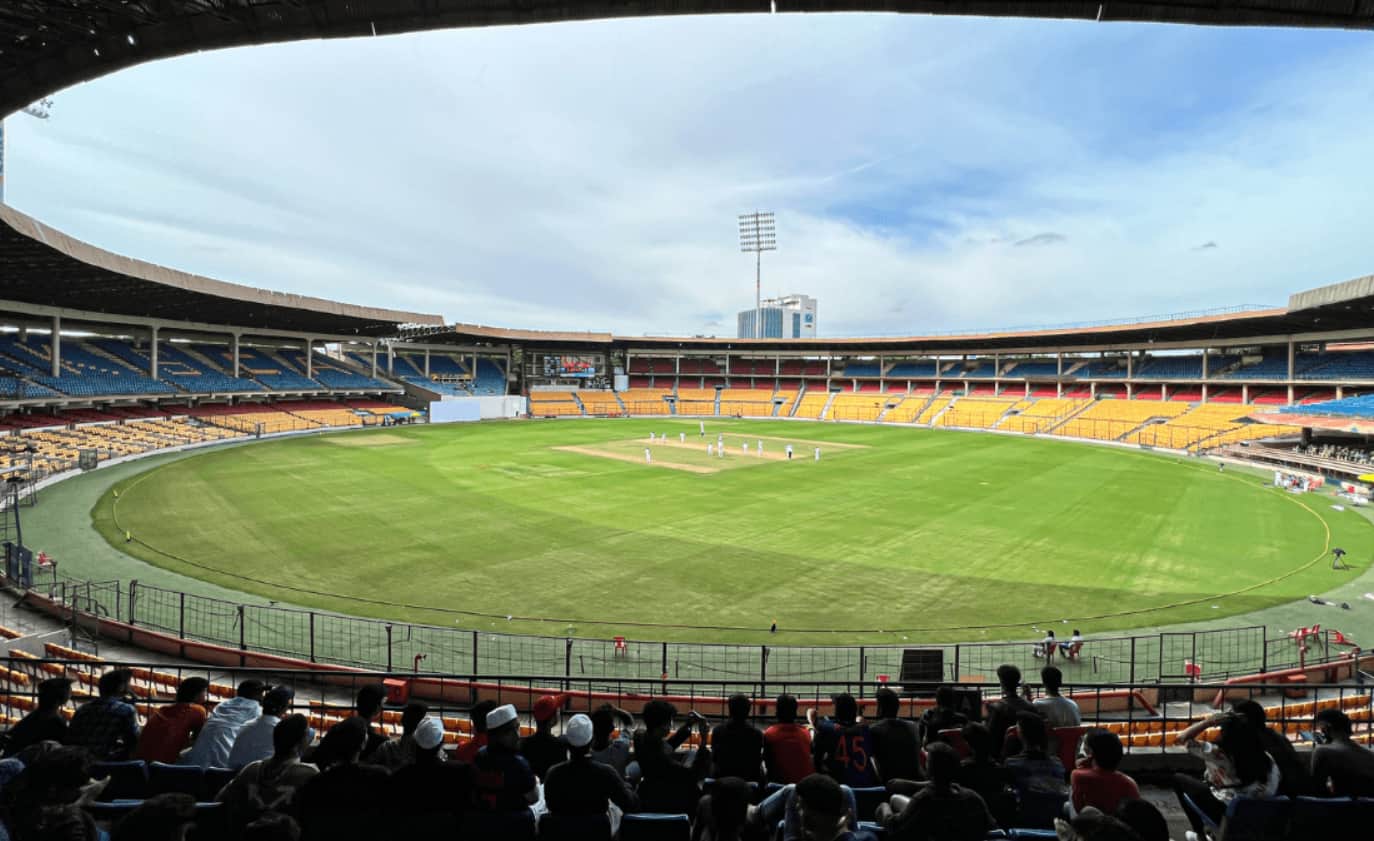
M Chinnaswamy Stadium Pitch Report: Key Facts
| Factor | Details |
|---|---|
| Stadium Location | Bengaluru, Karnataka |
| IPL Home Team | Royal Challengers Bengaluru |
| Pitch Nature | Flat, True Surface |
| Batting Friendly Rating | Extremely High |
| Average First Innings Score | 176+ runs |
| Recommended Toss Decision | Chase |
| Dew Impact | Heavy (Evening Matches) |
The numbers don’t lie. Teams batting second win nearly 60% of matches here. That’s not a coincidence.
How Does the M Chinnaswamy Stadium IPL Pitch Report Today Differ From Other Venues?
Unlike Chennai’s turning tracks or Mumbai’s bouncy surfaces, Chinnaswamy offers something different: predictability.
The pitch stays consistent through 20 overs. What you see in over three is what you’ll get in over seventeen. Hard surface, true bounce, minimal seam movement.
Batters love this. They can commit to shots earlier without worrying about variable bounce. The ball comes onto the bat cleanly.
Spinners get their turn, but it’s earned through skill. The pitch won’t do the work for them as it does at Chepauk or Eden Gardens.
Fast bowlers can extract pace, but not swing. Any movement comes from the bowler’s wrist, not the surface.
This creates a mental challenge. Bowlers arrive knowing the conditions won’t help them. That psychological weight shows in the scorecard every single match.
M Chinnaswamy Stadium IPL Pitch Report Scorecard Analysis
Here’s what actual match data reveals:
| Match Phase | Average Runs Scored | Wickets Lost |
|---|---|---|
| **Powerplay** (1-6 overs) | 55-65 runs | 1-2 wickets |
| Middle Overs (7-15) | 85-95 runs | 3-4 wickets |
| **Death Overs** (16-20) | 65-75 runs | 2-3 wickets |
| Total First Innings | 185-200+ runs | 6-8 wickets |
Notice the powerplay scoring rate. At most venues, 45-50 is standard. Chinnaswamy adds an extra 10 runs before the field spreads.
That gap compounds. By the fifteenth over, teams are already 15-20 runs ahead of typical venue pars.
Chinnaswamy Stadium Pitch Report Batting or Bowling Perspective
From a batting viewpoint, this pitch rewards confidence. The surface doesn’t change character mid-innings.
If you’re timing it well in the sixth over, you’ll time it well in the sixteenth.
Short boundaries at square and backward square (62-68 metres) mean placement beats power.
You don’t need to miss every shot. A top edge clears the rope. A mishit pull still finds the boundary.
From a bowling angle, variation saves careers here. Yorkers at the death, slower balls in the middle overs, and smart field placement become non-negotiable.
Economy rates suffer universally. A bowler going at 8.5 per over at Chinnaswamy might go at 7 per over elsewhere. The venue inflates numbers.
Smart captains rotate bowlers carefully. Overusing anyone, even your best option, leads to punishment.
M Chinnaswamy Stadium IPL Pitch Report RCB Home Advantage
RCB knows this pitch better than any visiting side. They’ve played 40+ matches here. That familiarity shows in selection and execution.
When RCB bats first, they target 200+ aggressively. They know anything below 185 puts pressure on their bowlers, who already face structural disadvantages.
When chasing, RCB batters play the percentages. They know which bowlers struggle at which ends. They know where boundaries are easiest to access.
Visiting teams often underprepare. They treat Chinnaswamy like a generic high-scoring venue without understanding the specific tactical adjustments required.
Chinnaswamy Stadium Pitch Report Cricbuzz Data Trends
Match records tracked across eight IPL seasons show consistent patterns:
- Totals above 200: Defended 65% of the time
- Totals between 175-200: Defended 35% of the time
- Totals below 175: Defended 18% of the time
The break point sits clearly at 200. Cross that threshold, and suddenly the chasing team’s advantage diminishes significantly.
Dew remains the wildcard. On heavy dew nights, even 210 can feel inadequate. The ball skids, spinners lose grip, and boundaries come easier in the second innings.
M Chinnaswamy Stadium Average Score in IPL Matches
- First innings average: 176.4 runs
- Second innings average: 168.2 runs
That eight-run gap seems small but reveals something critical.
Teams batting first often lose wickets pushing for 200+.
Teams chasing play percentage cricket and win without maximizing totals.
The highest successful chase here was 215 (CSK vs RCB, 2022).
Ruturaj Gaikwad and Devon Conway made it look routine on a dewy evening.
The lowest defended total was 131 (RCB vs KKR, 2008). Different era, different conditions, different strategies.
Modern IPL at Chinnaswamy demands 190+ to feel competitive.
M Chinnaswamy Stadium IPL Records You Should Know
| Record Category | Details |
|---|---|
| Highest Team Total | 263/5 (**RCB** vs PWI, 2013) |
| Lowest Team Total | 49 (SRH vs **RCB**, 2017) |
| Best Bowling Figures | 5/18 (Yuzvendra Chahal) |
| Highest Individual Score | 175* (**Chris Gayle**, 2013) |
| Most Sixes in Innings | 17 sixes (Gayle’s 175*) |
| Most Runs in Single Over | 37 runs (Gayle vs PWI, 2013) |
Chris Gayle’s 175 remains untouchable. Sixty-six balls, thirteen fours, seventeen sixes.
The pitch helped, but execution mattered more.
The 49 all-out shows the other extreme. When batting collapses happen here, they’re catastrophic.
The same pitch that rewards confidence punishes hesitation brutally.
Why Chinnaswamy Pitch Favours High Scoring in IPL?
Four structural factors combine:
- Altitude: Bengaluru sits 920 metres above sea level. Thinner air means the ball travels further. A shot that’s caught at Wankhede clears the rope here.
- Boundary dimensions: Square boundaries at 65 metres make pull shots and cuts extremely profitable. Even mis-timed strokes clear the rope regularly.
- Surface hardness: The pitch is compact and firm. Balls don’t grip or die. Batters get full value for shots, and the outfield speed compounds this.
- Consistent bounce: True bounce throughout the innings removes uncertainty. Batters commit earlier, play through the line, and generate higher bat speed.
These factors don’t operate independently. They amplify each other, creating scoring conditions unlike anywhere else in the IPL.
Toss Impact at M Chinnaswamy Stadium IPL Matches
Winning the toss matters. Teams bowling first win roughly 40% of matches. Teams chasing win 60%.
Dew explains part of this. Evening matches see heavy dew after 8:30 PM.
The ball becomes slippery. Spinners can’t grip it. Fast bowlers struggle with wet run-ups.
But even accounting for dew, chasing holds advantages. You know the target.
You know the required run rate. You can calculate risks precisely.
Batting first means guessing par. Set 175, and you might be 20 short.
Set 200, and you’ve used resources chasing a score that might not be necessary.
Smart captains chase when they win the toss here.
The exception: when your batting lineup is fragile, or your death bowling is elite.
Top Performers at M Chinnaswamy Stadium in IPL History
Batters who dominate:
- Virat Kohli: Over 900 runs at this venue. Knows every angle, every boundary, every bowling matchup.
- AB de Villiers: His 360-degree game was built for these dimensions.
- Glenn Maxwell: Accesses boundaries from impossible positions.
Bowlers who survive:
- Yuzvendra Chahal: Creates wickets through flight and deception, not surface help.
- Mohammed Siraj: Early swing in powerplay before the pitch settles completely.
- Harshal Patel: Death over variations and slower balls prove effective.
Notice something. The successful bowlers don’t rely on pitch assistance. They succeed despite conditions, not because of them.
Expert Insight: Reading This Pitch During Live Matches
Watch how batters play the first three overs. If they’re driving on the up comfortably, expect 200+.
If they’re playing late and waiting on the ball, the pitch might be offering slight grip.
Check square boundaries early. If pulls and cuts are clearing easily, adjust your scoring expectations upward immediately.
Monitor dew from the tenth over of the second innings. If fielders are wiping their hands between deliveries, the chasing team’s advantage just increased significantly.
Don’t trust powerplay scores alone. The real indicator is over 7-10. If teams maintain scoring rates through that phase, totals will be massive.
Fantasy Cricket Strategy for M Chinnaswamy Stadium Matches
- Captain choices: Prioritize top-order batters. An opener scoring 80 delivers more fantasy points than any bowler taking three wickets here.
- Bowler selection: Pick wicket-takers, not economy bowlers. A 3/45 performance beats 0/32 in fantasy scoring every time.
- All-rounders: Premium picks at this venue. Batting at five or six while bowling middle overs gives dual scoring opportunities.
- Avoid: Defensive spinners who bowl tight but don’t take wickets. Their upside is capped at venues like this.
- Multiplier strategy: Use captain/vice-captain on aggressive top-four batters. The risk-reward heavily favours this approach at Chinnaswamy.
How to Use This M Chinnaswamy Stadium IPL Pitch Report?
Before match day:
- Check the weather for dew predictions
- Review team batting orders for top-heavy lineups
- Identify bowlers with death-over variations
- Compare the venue records of both playing XIs
During the match:
- Adjust expectations based on the toss
- Monitor first innings scoring phases
- Watch for dew development
- Track bowling changes and field placements
For betting or fantasy:
- Weight top-order batters heavily
- Factor altitude into six-hitting predictions
- Assume totals 10-15 runs higher than other venues
- Trust chase-friendly trends in close decisions
FAQs on M. Chinnaswamy Stadium IPL Pitch Report
- Is M. Chinnaswamy Stadium good for batting in IPL?
Yes, extremely. The flat pitch, true bounce, and short square boundaries make it one of the best batting venues in IPL. Teams regularly score 180-200+.
- What is the average score at Chinnaswamy in IPL?
First innings averages 176 runs. Competitive totals start at 185. Anything below 175 is considered below par and difficult to defend.
- Should teams bat or bowl first at Chinnaswamy?
Chasing is preferred. Teams batting second win 60% of matches. Dew and knowing the target both favour the chasing side significantly.
- Why do bowlers struggle at M Chinnaswamy Stadium?
Short boundaries, altitude, hard pitch, and true bounce all favour batters. Bowlers get no assistance from the surface and must rely purely on skill.
- Which IPL bowlers have the best records at Chinnaswamy?
Yuzvendra Chahal leads with 30+ wickets. Mohammed Siraj and Harshal Patel also perform well through variations rather than pitch assistance.
Final Analysis: M. Chinnaswamy Stadium IPL Pitch Report
Chinnaswamy doesn’t reward conservative cricket. Teams that come here planning to grind out 160 lose.
Teams that commit to aggressive batting and smart bowling survive.
The pitch won’t change. The boundaries won’t move. The altitude remains constant.
What changes is how you adapt.
Treat 190 as your baseline par. Build fantasy teams around top-order aggression.
Pick wicket-taking bowlers over economy specialists.
And if you win the toss, chase. The data is clear on that point.
Understanding this venue separates informed analysis from guesswork.
Every IPL season, several matches get decided by teams that either respected Chinnaswamy’s nature or ignored it.
Don’t be the team that ignores it.
About the Author
